
Performance Recovery
Hunt the Origin: Tim Washburn's Story and the Philosophy Behind Thera Performance Lab
Tim Washburn broke his neck in three places, spent days in a coma, and was told he might never walk again. Here is how that experience and 25 years on the jiu-jitsu mat built the philosophy behind Thera Performance Lab.
Start Feeling Better Today
Stop managing pain. Start hunting the cause.
$99 · No Referral Needed
The guide · 13
- 01Quick Answer
- 02From Athlete to Entrepreneur
- 03The Accident That Changed Everything
- 04The Gap That Built Thera Performance Lab
- 05The Kinetic Chain: Why It Matters
- 06Why Repetitive Movement Creates the Problem
- 07The RX2600 Therapeutic Robot
- 08The Thrive Not Survive Mindset
- 09FAQs
- 10Resources
- 11About the Authors
- 12Ready to Find the Actual Cause?
- 13Ready to find the root cause?
This post is based on Tim's full conversation with the 1st Optimal Podcast. Watch the full episode above.
Quick Answer
Thera Performance Lab was built by Tim Washburn after a near-fatal accident and years of frustration with traditional physical therapy showed him exactly what was missing. The clinic combines complete kinetic chain assessment with the RX2600 Therapeutic Robot and advanced hands-on modalities to find the root cause of pain, tightness, or reduced mobility and fix it. Not manage it.
From Athlete to Entrepreneur
Tim's identity was built on sport from the beginning. Hockey and soccer at competitive travel levels through childhood. When his hockey career ended in his twenties, coaching filled the gap. Hockey camps, private lessons, putting himself through college one session at a time.
But coaching was, in his own words, a band-aid.
"Losing that you lose your identity a little bit. Coaching hockey helped with that quite a bit. But it was kind of a band-aid. It didn't really fully take care of that need to push myself."
Jiu-jitsu became the answer. Over 25 years on the mat, Tim Washburn, hockey coach, jiu-jitsu black belt, attorney, and co-founder of Thera Performance Lab, developed a deep understanding of how the body moves, how it takes damage, and how it recovers. That understanding would matter more than he knew.
The Accident That Changed Everything
A large section of a tree fell on Tim's head from approximately 40 feet. His neck broke in three places. Traumatic brain injury. Four days in a coma. When he came out of it he had about an inch of edema across his back, could barely open his jaw, and could not walk without shuffling.
His neurosurgeon told him he probably would not work again and would be lucky to walk.
Tim's response was direct.
"Me being me and such a nice person told him I'm walking out of here this week."
He did. But the real recovery started after he got home. Tim, a lifelong athlete who had done lunges since he was four or five years old, did his first lunge and fell over.
"I've done a lunge my whole life. And now you're this person who can't do what you could always do. It was emotional and it was hard."
What came next was not a standard recovery. Tim sought out unconventional approaches. Cash-pay therapists who thought outside the insurance model. People who asked what he wanted to get back to instead of telling him what he could no longer do.
He noticed something in the contrast between those two worlds. That gap became Thera Performance Lab.
The Gap That Built Thera Performance Lab
Traditional physical therapy frustrated Tim, not because the therapists were bad, but because the system they operated inside was built to produce limited results.
"In physical therapy you get to bill for each line item, each service. If they don't do multiple services they cannot make a living. The way the insurance model is set up is to fail. You're going to get poor care because they can't make a living and give you good care."
He knew from personal experience what care looked like when those constraints were removed.
"I want to offer Ferrari medicine. Ferrari care for people who want more than traditional physical therapy models."
That conviction became Thera Performance Lab. A cash-pay performance recovery center where every session is one on one with your Doctor of Physical Therapy, the treatment is built entirely around what your specific body needs that day, and the only goal is getting you back to doing what you love.
"You don't come in and pay for a service at our clinic. I don't know what you're going to get tomorrow or your next session. No one session might be the same. What do you need today?"
The Kinetic Chain: Why It Matters
Tim's explanation of the assessment philosophy is the clearest version we have heard.
"If your feet hurt when you run, we're going to look at your foot, your toes, your ankle, your knee, your hip, your sacrum, your pelvis. What is going on and why do his feet hurt? We're not going to say Joe's feet hurt because he runs 50 miles a week. We want you to run 100 miles a week."
The upper body kinetic chain runs from hands to elbow to shoulder to scapula to rib cage to cervical and thoracic spine. The lower body chain runs from feet to ankle to knee to pelvis and SI joint to lower back to the thoracolumbar junction. Every link connects. When one link breaks down every other link compensates.
Research shows that kinetic chain characteristics play a critical role in how pain develops and where it shows up, and that it is almost never where it started.
Over time those compensations show up as pain, tightness, or reduced mobility. This is the core of the Complete Kinetic Chain Assessment.
"Where you're feeling the pain, it's probably not the cause of your pain. You come in and complain about your shoulder. We're going to back up to your spine, to your rib cage, to your scapula, go down to your elbow, down to your wrist, down to your hand, down to your fingers, and see how it's all moving."
An international consensus panel of physical therapy experts confirmed that kinetic chain clinical reasoning is best practice for treating shoulder pain, validating exactly the methodology used at Thera Performance Lab.
Why Repetitive Movement Creates the Problem
Most pain is the result of patterns built up over years of sport, work, or daily life. The same swing. The same stride. The same desk posture. The same side of your body absorbing everything.
Mass General Brigham explains that whenever you repeat a movement as part of your regular routine, you are working the same set of muscles and joints, and excessive repetitive motion may be harmful over time.Tim describes it clearly.
Peer-reviewed research shows that repetitive submaximal loading, the kind that happens with thousands of golf swings or running strides, causes mechanical fatigue in tissue that predisposes it to failure even during seemingly normal movements. Studies also confirm that body asymmetry, where one side consistently absorbs greater mechanical stress, leads over time to overuse injuries in joints, tendons, and soft tissue."You brush your teeth with your right hand or your left hand. You put your left elbow on your desk all the time. You drink coffee with your right hand. We are all walking overuse injuries just because of our habits."
This is exactly what the Complete Kinetic Chain Assessment is designed to find and correct. Learn more about our approach and how we assess the full body as a connected system.
The RX2600 Therapeutic Robot
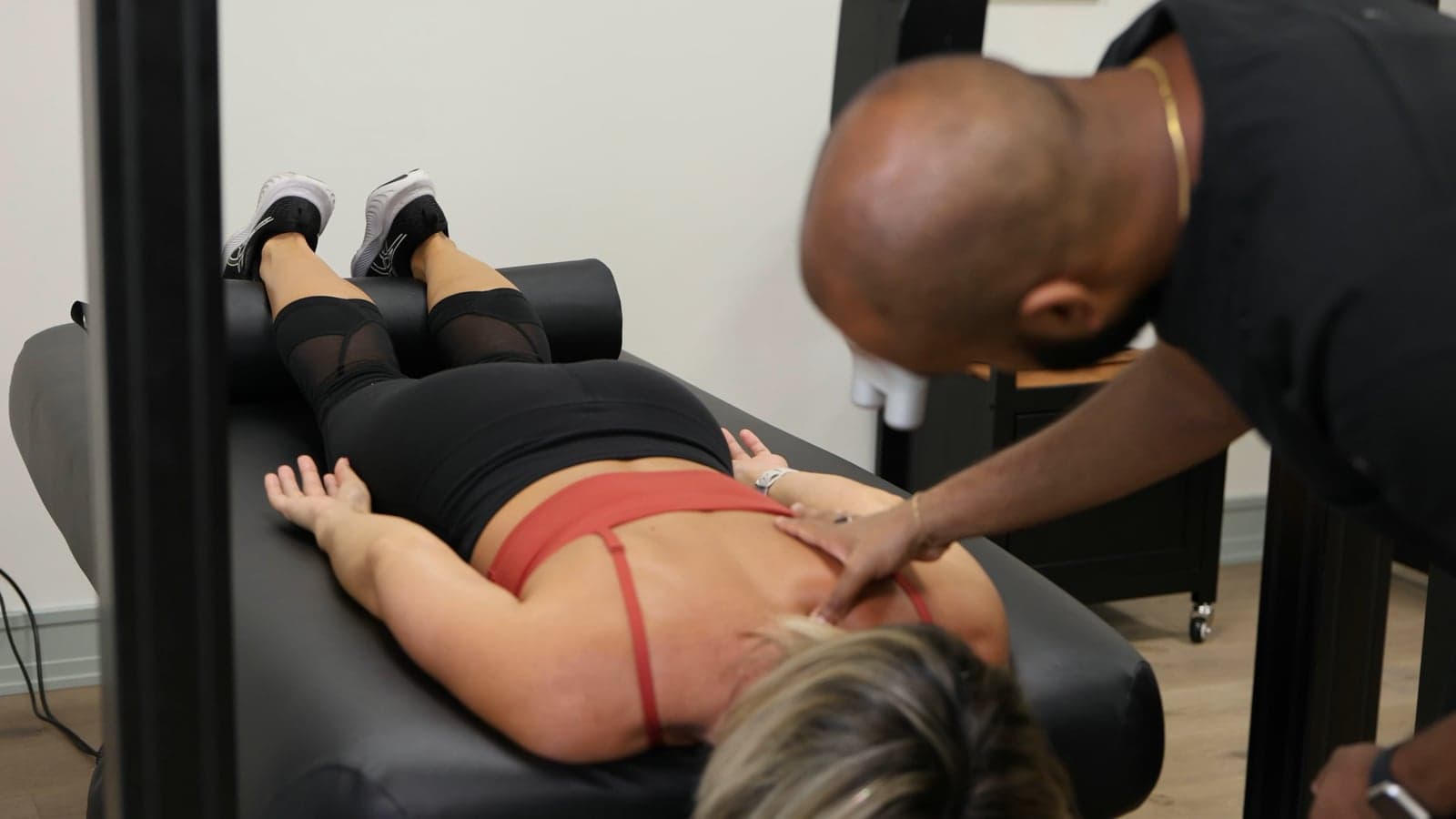
Thera Performance Lab uses the RX2600 Therapeutic Robot, an FDA-cleared robotic therapy system. Tim explains what it actually does.
"It creates very precise, constant pressure with heat and vibration. I don't care how good the therapist is at the 10th hour. They're not the same therapist they were in the first hour. My RX2600 Therapeutic Robot is the same on hour 10."
The RX2600 Therapeutic Robot delivers sustained pressure at depths hands cannot consistently reach. Combined with heat and vibration it penetrates tissue in ways no manual technique can replicate with the same consistency. Tim brought in a 350-pound powerlifter to demonstrate it. The RX2600 Therapeutic Robot worked on him for three hours straight.
"He laid on that table for three hours because he's never felt anything like that before."
Learn more about the RX2600 Therapeutic Robot and how it works at Thera Performance Lab.
The Thrive Not Survive Mindset
Tim has been saying thrive not survive for as long as we have known him. It is not a tagline. It is the lens through which he sees health, recovery, and what it means to live well.
"My mindset's always been to thrive, not survive. Don't just do what you can do to get through the day. Let's be our best selves. And with the way I live at my age, I can't do that without recovery and I can't do that without maintenance and I can't do that without care when I'm injured."
That mindset is who Thera Performance Lab was built for. The active adult who is not ready to slow down. The weekend warrior who has been told to stop doing what they love. The person who has tried everything and is done with temporary answers.
"Don't wait till your arm's sideways. Come in when you're tight. Come in when you're not feeling right. Employ that mindset to get better. To thrive. Not just to survive and get through life."
FAQs
### What is the Complete Kinetic Chain Assessment?
It is a full clinical evaluation of how your entire body moves together, upper body and lower body assessed as one connected system. Your Doctor of Physical Therapy maps the entire chain, finds where the movement broke down, and identifies the actual source of your pain, tightness, or reduced mobility. You leave with a clear answer and a precise recovery plan.
### What is the RX2600 Therapeutic Robot and how is it different from regular massage?
The RX2600 Therapeutic Robot is an FDA-cleared robotic therapy system that delivers sustained pressure, heat, and vibration with a consistency and depth that hands alone cannot match. It does not get tired. It applies the same precise pressure at hour one as it does at hour three. Thera Performance Lab is the only clinic in the region using the RX2600 Therapeutic Robot as part of a complete kinetic chain treatment protocol.
### Do I need a referral to book an appointment?
No. You can book directly online or call 248-690-5444. No referral needed. No insurance required.
### How is Thera Performance Lab different from regular PT?
Most physical therapy clinics operate within an insurance model that requires billing for multiple line items, limits session time, and ties treatment to diagnosis codes rather than the actual person. Thera Performance Lab is cash pay only. Every session is one on one with your Doctor of Physical Therapy. No aides. No handoffs. No protocol written for someone else's body.
### Is Thera Performance Lab only for athletes?
Not at all. Tim tells the story of an elderly woman who almost did not come in because she thought Performance Lab meant it was for athletes. She came in, felt better after one visit, and came back the following week. The performance mindset is for anyone who wants to live actively and move well, whether that means competing in jiu-jitsu or carrying groceries without pain.
### Where are you located and how do I book?
Thera Performance Lab is located at 146 S Broadway St #160, Lake Orion, MI 48362. We are open Tuesday through Friday 8:00 AM to 7:00 PM. Book your $99 Complete Kinetic Chain Assessment online or call 248-690-5444.
Resources
Research consistently supports the kinetic chain approach to identifying and treating pain at its actual source rather than where it shows up.
Journal of Shoulder and Elbow Surgery: International consensus panel confirms kinetic chain clinical reasoning as best practice for shoulder pain treatment. PLOS ONE 2024: Systematic review confirms kinetic chain characteristics are central to understanding and treating shoulder pain in non-athletes. Peer-reviewed research: Repetitive submaximal loading predisposes tissue to failure during normal movement. Sports injury research: Body asymmetry and repetitive loading patterns lead to overuse injuries in joints, tendons, and soft tissue. Mass General Brigham: Repetitive motion injuries explained, causes, and prevention. 1st Optimal Podcast: Back to What You Love, Recovery and Balance with Tim Washburn.About the Authors
This article was written and reviewed by the licensed physical therapists at Thera Performance Lab, a performance recovery center in Lake Orion, Michigan. Our team, led by Dr. Mani, DPT, RPT, TPI Certified, helps active adults and athletes restore mobility, relieve pain, and get back to doing what they love through complete kinetic chain assessment and advanced hands-on care. To learn more about our team, visit our About page.
Ready to Find the Actual Cause?
If your pain, tightness, or reduced mobility keeps coming back it is almost always a sign that the actual source has not been found yet.
At Thera Performance Lab in Lake Orion, your Doctor of Physical Therapy assesses the full kinetic chain, identifies the root cause, and builds a precise personalized plan to fix it.
Call now or book online to schedule your Complete Kinetic Chain Assessment.
Ready to find the root cause?
If you've been working through back pain and want a root-cause path forward, this is the work Thera Performance Lab does every day. Sessions run inside our Pain Relief & Mobility track, typically anchored by the RX2600 Therapeutic Robot as one of the precision tools in a personalized kinetic-chain plan.
Book a Complete Kinetic Chain Assessment — $99, no referral needed.