plantar fasciitis
Find Lasting Relief from Plantar Fasciitis in Lake Orion: A Root-Cause Guide
Heel pain is the last link in a long load chain. If stretching, rolling, and rest keep failing, the cause is probably three joints up. A root-cause guide for active adults in Lake Orion who refuse to slow down.
Start Feeling Better Today
Stop managing pain. Start hunting the cause.
$99 · No Referral Needed
The guide · 8
- 01The kinetic chain angle
- 02How we treat this one-on-one at Thera Performance Lab
- 03Plantar Fasciitis Causes
- 04Plantar Fasciitis Relief
- 05Sharp Pain in the Heel With the First Steps in the Morning
- 06Pain That Improves with Walking but Returns After Rest
- 07Frequently asked questions
- 08Ready to find the root cause?
You typed it into your phone at 6 a.m. with the heel still screaming from the first step out of bed: chronic plantar fasciitis won't heal Lake Orion. You've iced it, rolled a frozen water bottle under the arch every morning, stretched the calf, bought the night splint, swapped the shoes, maybe taken a cortisone shot that bought six good weeks before the stab came back. So you already know the standard playbook treats the heel like the problem. Here's the part nobody tells the won't-slow-down crowd: the fascia on the bottom of your foot is the last link in a long chain, and it keeps failing because of what's happening above it. Calm the heel, ignore the chain, and you'll be back next season.
The kinetic chain angle
The pain shows up at the heel. It almost never starts there. The plantar fascia is the bottom of a load chain that runs from your hip down through the knee and ankle into the ground, and every step that chain is supposed to share the work of absorbing impact and rotation. When a link upstream stops doing its part (a hip that lost rotation, a knee that collapses inward, an ankle that lost dorsiflexion), the fascia gets handed force it was never built to absorb. So it gets pulled, compressed, and inflamed far beyond its normal function.
That's why local fixes feel good for a day. Stretching the calf and rolling the arch reduce the load right where it hurts, so the tissue calms down. But the hip that still isn't rotating tomorrow dumps the same overload back onto the fascia, and the cycle resets. The real question isn't "how do I calm the heel?" It's "what upstream is forcing the heel to absorb this much?"
How we treat this one-on-one at Thera Performance Lab
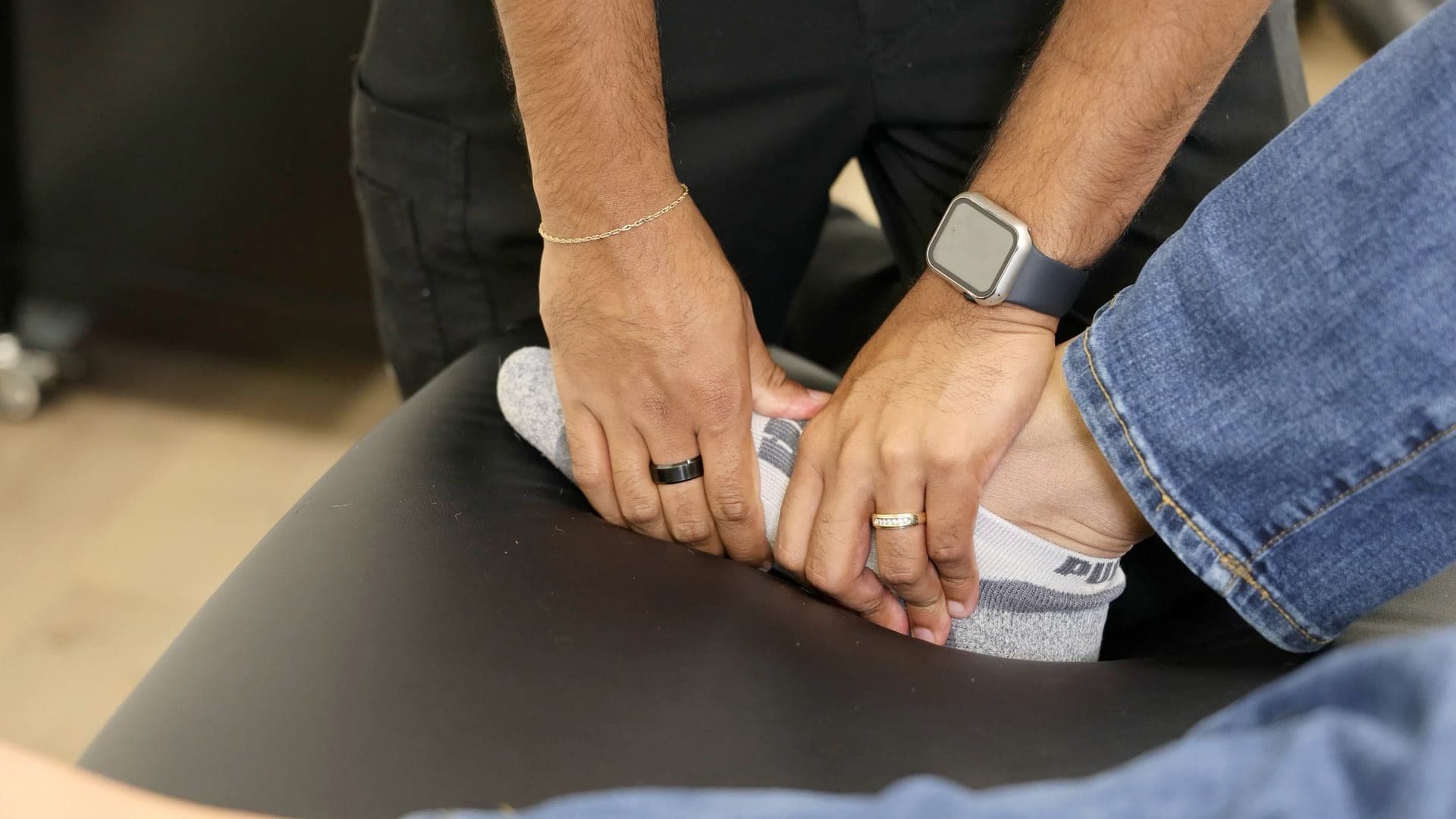
Every plan at TPL starts with the Complete Kinetic Chain Assessment: one hour, one-on-one with Dr. Mani, our Doctor of Physical Therapy. He doesn't press on your heel and hand you a stretch sheet; he maps the whole chain: ankle mobility, hip rotation and control, how the knee tracks, how the foot strikes the ground. By the end of the hour you know which links are driving the overload, not just where it hurts.
From there we build the plan around what your chain is doing, not a diagnosis code. We work outside the insurance model, so sessions run as long as the work requires: cash-pay, HSA and FSA accepted, receipts available for out-of-network reimbursement. Early sessions usually combine depth-controlled tissue work via the RX2600 Therapeutic Robot on the fascia, calf, and Achilles (releasing restriction hands alone can't sustain) with the manual therapy and movement retraining that change how load travels through the chain. The goal is change you can feel between sessions, not relief that's gone by morning.
Plantar Fasciitis Causes
Ask what causes the condition and most answers stop at the foot: tight calves, flat arches, bad shoes, too many miles. Those matter, and the Mayo Clinic's overview covers them well, but they're downstream symptoms of a loading problem, not the root. The causes that keep it chronic live up the chain.
Lost ankle dorsiflexion is the big one. When the ankle can't bend far enough for the shin to travel over the foot, the arch collapses and the fascia stretches hard at the worst moment of every step, and limited dorsiflexion is one of the most consistent risk factors in the research (Riddle et al., PubMed). A hip that lost internal rotation forces the lower leg to rotate through the foot, grinding torque into the fascia. Weak hip stabilizers let the knee dive inward, flattening the arch from above. Add a calf and Achilles shortened from years of compensation, and the fascia is overloaded from both ends.
None of that shows up when you only look at the heel. It shows up when someone watches how your whole leg meets the ground. For the full anatomy, our condition deep-dive breaks the chain down in detail.
Plantar Fasciitis Relief
Real relief comes in two layers, and most people only ever get the first. Layer one calms the angry tissue: deep, depth-controlled work on the fascia, calf, and Achilles, often paired with dry needling on calf trigger points that can change how the foot feels in a single session. This is the layer ice, rolling, and a night splint are chasing: real relief, but temporary on its own.
Layer two is the one that makes it last: changing the upstream inputs that decide how much load the fascia absorbs at all. Restore the ankle dorsiflexion the foot needs to roll forward. Rebuild the hip rotation and control that keep the knee and arch from collapsing. When the upstream mechanics change, the fascia stops getting overloaded with every step, and the relief holds because the cause is gone, not just quieted.
That two-layer approach is what our Pain Relief & Mobility track is built around, not a stretch handout you've already tried, but a plan that traces the pain back to the link driving it, then changes it.
Sharp Pain in the Heel With the First Steps in the Morning
That first-step-in-the-morning stab is the most recognizable sign of the condition, and one of the most misread. Overnight your foot rests in a slightly pointed position and the fascia shortens and tightens. You stand up, dump your full bodyweight onto cold, contracted tissue before it's had a chance to lengthen, and the sharp pain in the heel with the first steps in the morning hits. After a few minutes of walking it warms up, lengthens, and the pain fades.
People read that fade-out as "it's getting better." It isn't. The fascia didn't heal between step one and step twenty, it just warmed up enough to tolerate the load. It tightens overnight for the same reason it's inflamed all day: a chain that hands it too much. Tight calves and a shortened Achilles make it worse, which is why stretching before your feet hit the floor helps for about ten minutes. Change the upstream loading and the morning stab stops being your alarm clock.
Pain That Improves with Walking but Returns After Rest
Pain that improves with walking but returns after rest confuses people, because it's the opposite of how an injury is "supposed" to behave. Most injuries hurt more the more you use them. The heel often feels better once you're moving, then stabs again the moment you stand up after sitting at your desk, finishing a long drive, or watching a movie.
The mechanism is the same as the morning stab, on a shorter clock: sit still and the fascia cools and shortens; load it cold and it protests; keep moving and it warms and quiets. That on-off pattern is a tell: tissue that's overloaded and reactive, not structurally destroyed, which responds fast once you take the overload away. So if walking helps and rest brings the pain back, the problem isn't that you move too much; it's how you load when you move. Fix the chain and the cycle loses its trigger.
Frequently asked questions
Why won't my plantar fasciitis heal, even after months of stretching and rest?
Because stretching and rest treat the heel, and the heel usually isn't the cause. If a stiff ankle or a tight hip keeps overloading the fascia every step, the tissue never gets a real break. It's just briefly calmed. Until the upstream mechanics change, the pain comes back. That's why a foot-only approach stalls and a kinetic-chain approach holds.
Do I need a referral or insurance to be seen in Lake Orion?
No referral, no insurance hoops. TPL works outside the insurance model, so you book directly and we spend the full hour on you. It's cash-pay; HSA and FSA are accepted, and we'll give you receipts if you want to pursue out-of-network reimbursement. Most people start with the $99 Complete Kinetic Chain Assessment and decide from there.
Will orthotics or new shoes fix it?
They can help by reducing load under the arch, which buys short-term relief. What they don't do is change why your foot loads wrong in the first place. Most people get further combining smart footwear with kinetic-chain treatment than with orthotics alone. If the ankle and hip never change, the fascia gets overloaded again the moment the shoe comes off.
Ready to find the root cause?
If your heel pain won't quit in Lake Orion no matter how many stretches, rollers, and shoe swaps you've tried, the Complete Kinetic Chain Assessment is the right next step. One hour, one-on-one with a Doctor of Physical Therapy, full-body. We don't treat where it hurts. We hunt what's causing it.
Book your $99 Complete Kinetic Chain Assessment, no referral needed. We're in Lake Orion, MI, serving active adults across metro Detroit.
Get in touch to book or ask a question first.