Blood Flow Restriction
Blood Flow Restriction Training for Injury Recovery: How BFR Rebuilds Strength Without Stressing Healing Tissue
Most injury recovery plans wait until tissue heals to start strength work. Blood flow restriction training closes that gap by building strength at twenty to thirty percent of normal load.
Start Feeling Better Today
Stop managing pain. Start hunting the cause.
$99 · No Referral Needed
The guide · 9
If you have ever recovered from an injury and watched your strength disappear faster than the pain did, you already know the problem with conventional rehab. By the time the tissue is ready to load again, the muscle around it has lost months of training. Blood flow restriction is the tool that solves that gap. And it is one of the most underused interventions in injury recovery.
Quick Answer
Blood flow restriction training, often called BFR, uses pressure cuffs placed on the limb to partially restrict venous return during low-load exercise. The result is a strength and hypertrophy response at twenty to thirty percent of your normal training load. For someone in injury recovery, this means you can keep building muscle and strength without driving heavy load through healing tissue. At Thera Performance Lab, BFR is administered by your Doctor of Physical Therapy during one-on-one sessions as part of a complete kinetic chain treatment plan.
Why Injury Recovery Loses Strength in the First Place
When an injury blocks normal movement, the affected segment stops getting loaded. A sprained ankle stops absorbing weight through its full range. A torn rotator cuff stops pressing overhead. A post-surgical knee stops doing the squat work the quad has been doing for years.
The body responds in days. Within a week of meaningful disuse, fiber recruitment drops. Within two weeks, measurable muscle atrophy begins. Within a month, the strength deficit is significant enough that a full recovery is no longer about healing the injured tissue. It is also about rebuilding everything that went off-line while waiting.
This is the second injury that most rehab plans ignore. The first injury is the structural one. The second injury is the strength loss that piled up during recovery. By the time conventional PT clears you to load again, you are not just rehabilitating the original problem. You are catching back up from weeks or months of accumulated deficit.
Blood flow restriction training is how that deficit gets prevented in the first place.
How BFR Builds Strength at Low Load
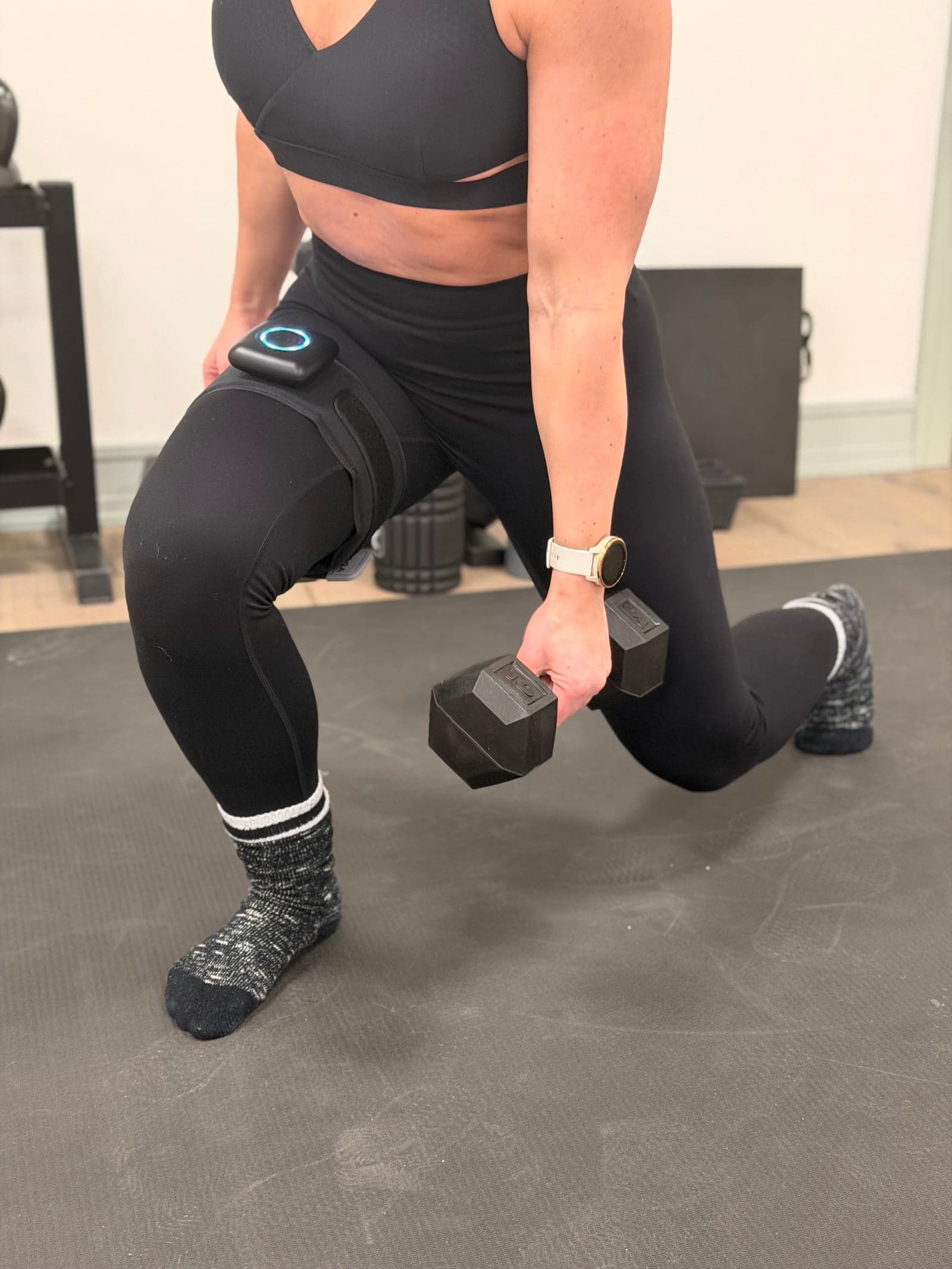
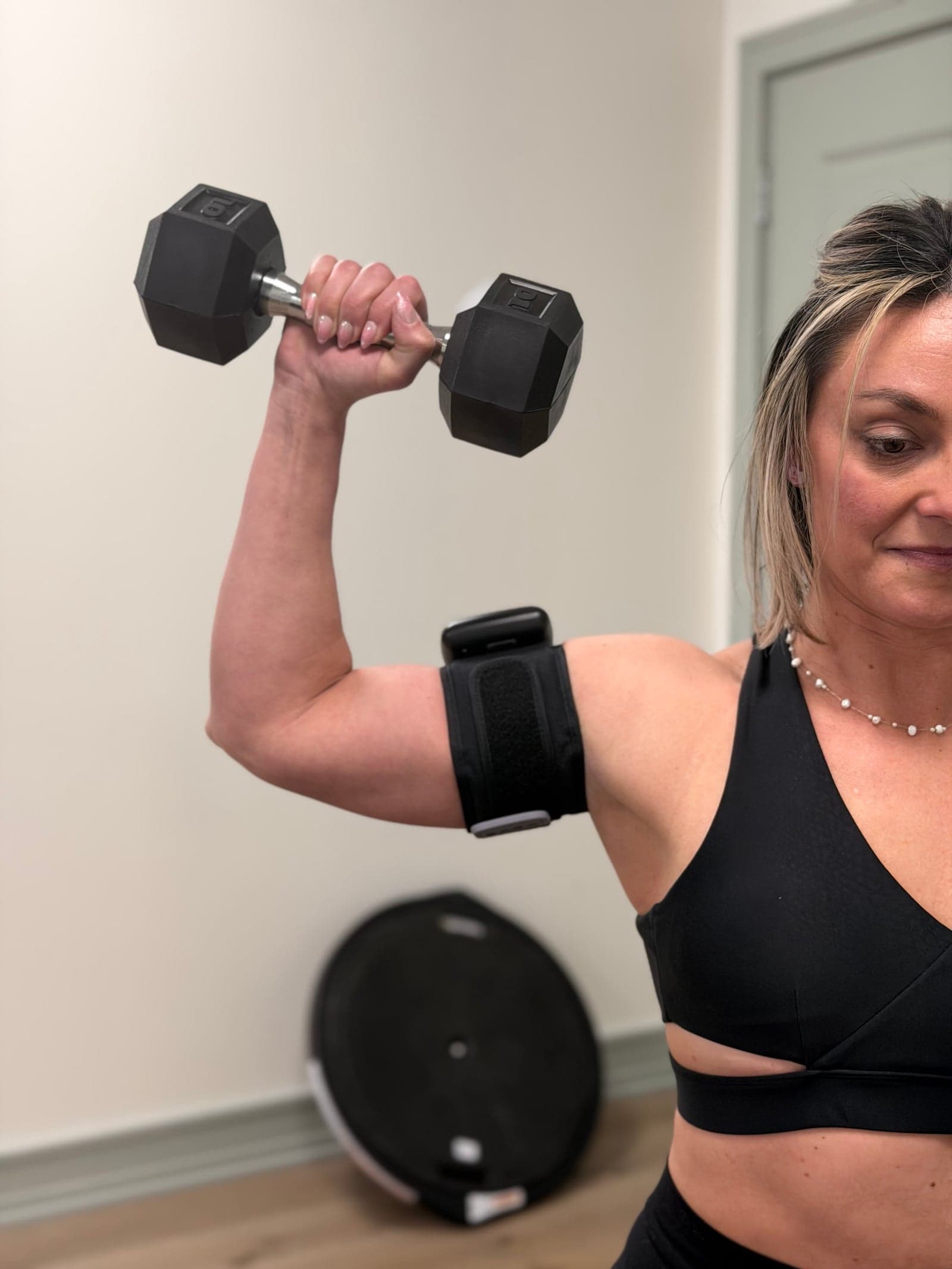
The science is simple in concept and exact in execution. A pneumatic cuff is placed on the upper arm or upper leg and inflated to a specific percentage of the pressure required to fully occlude the artery. Arterial inflow is preserved. Venous outflow is partially restricted. The working muscle below the cuff fatigues quickly during low-load exercise, recruits high-threshold motor units that normally only fire under heavy load, and triggers the same growth and strength signals that come from training at eighty percent of one-rep max.
You get the muscle-building stimulus of heavy training while loading the joint at light-training weights. For injury recovery, that is the entire game.
Peer-reviewed research has shown BFR produces measurable strength gains in rehab populations who could not otherwise tolerate heavy loading. The clinical application has been validated across post-surgical, post-injury, and chronic-pain protocols.
The Kinetic Chain Angle
Here is what most injury-recovery plans miss. The injured tissue is rarely the only thing that needs strengthening.
A knee injury affects how the hip loads. A shoulder injury affects how the thoracic spine and scapula coordinate. An ankle injury reshapes the entire lower chain because the foot strike is now compensating to avoid pain.
When one link in the kinetic chain goes off-line, the whole chain rewires around the loss. By the time the injured tissue is healed, the chain has built six to twelve weeks of compensation patterns. The hip has learned to rotate differently. The opposite leg has been doing extra work and has built strength imbalances of its own. The thoracic spine has lost rotation it used to have.
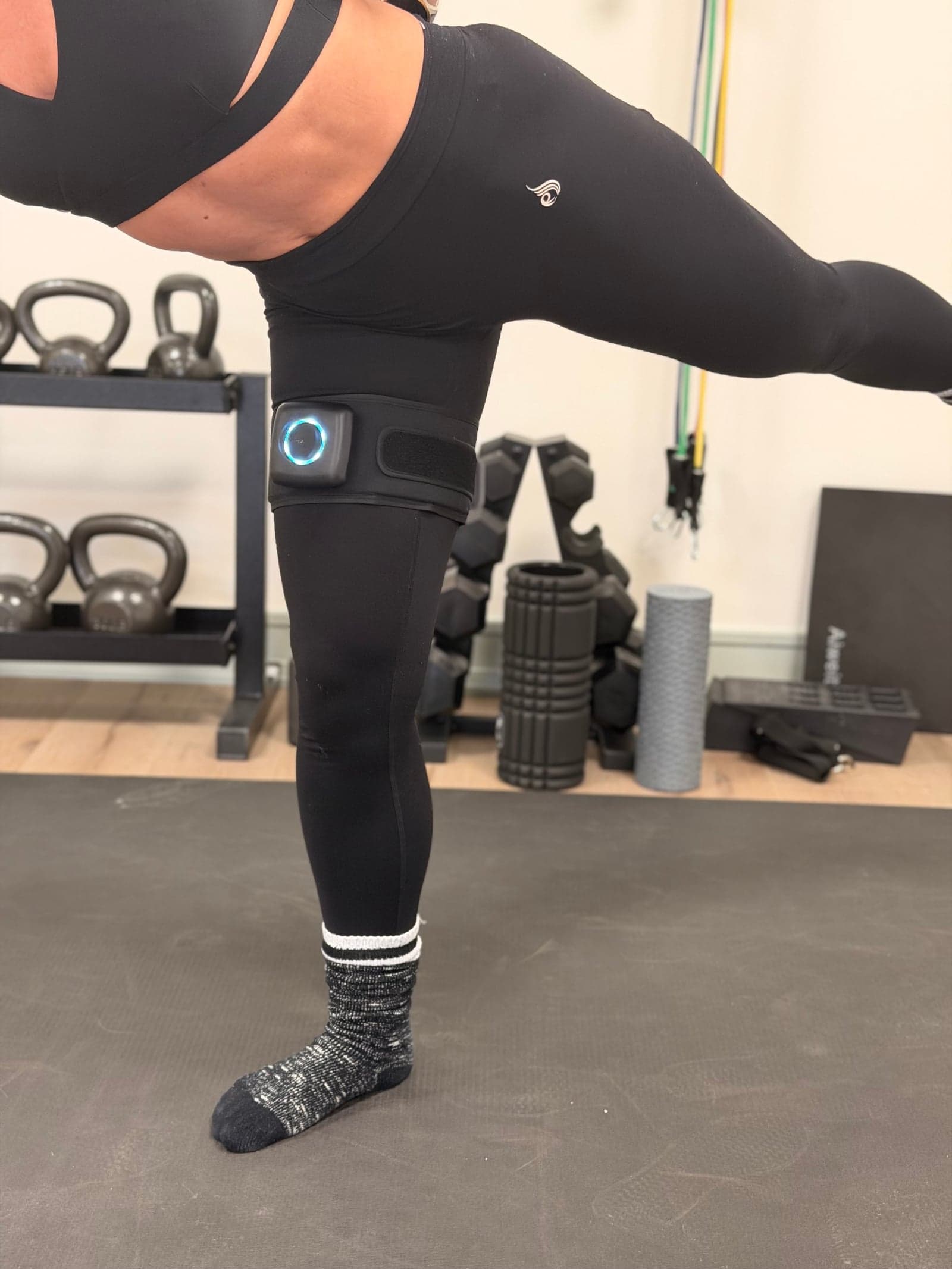
BFR is a tool that lets every other link in the chain keep training while the injured link heals. The hip keeps loading. The opposite limb keeps training symmetrically. The thoracic spine keeps moving through full range. When the injured tissue is ready to return to load, the chain around it has not been allowed to drift into compensation patterns it now has to undo.
This is why BFR is most powerful inside a full kinetic chain assessment and treatment plan, not as a standalone gym intervention. It is one input. The chain is the framework.
How Thera Performance Lab Uses BFR in Injury Recovery
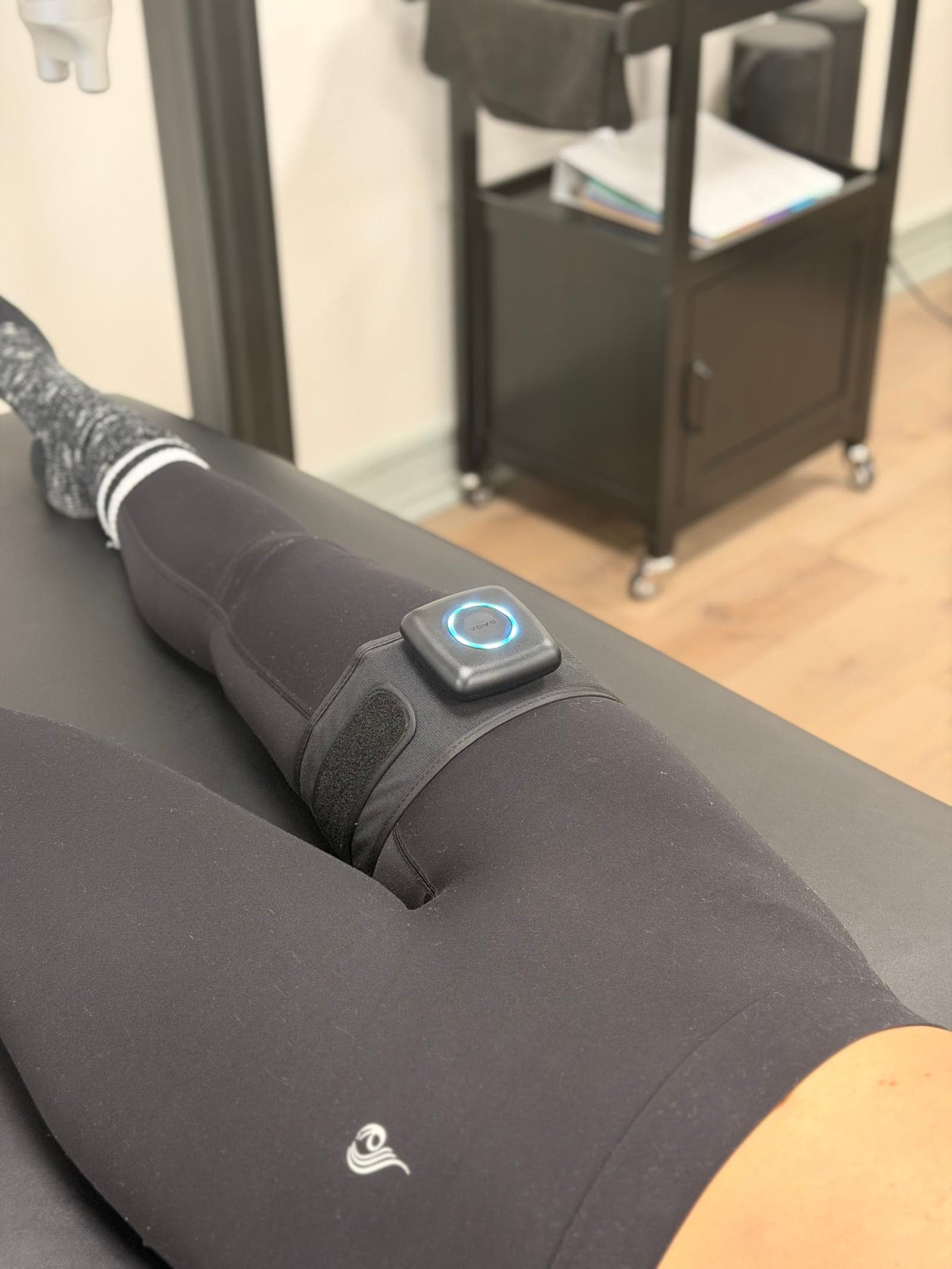
At TPL, BFR therapy is administered in-house, in the session, by your Doctor of Physical Therapy. We use SAGA BFR Cuffs, built by sport scientist Dr. Mike MacPherson, PhD, CSCS, specifically because they are wireless and auto-calibrating. That matters in a clinical setting.
Manual BFR systems require the clinician to take a Doppler reading, dial in a pressure cuff, and hope the cuff stays at the right percentage through the set. SAGA's cuffs read limb size and calibrate the occlusion percentage automatically, holding it through the set and logging it. Your therapist runs the protocol. The equipment gets out of the way.
A typical injury-recovery BFR session at TPL fits inside a longer treatment hour. Your Doctor of Physical Therapy assesses the injured limb and the unaffected side, places the cuffs on whichever limb the plan calls for, calibrates to your specific occlusion percentage, and runs three to four sets of a chosen exercise at low load. The clinician is in the room the entire time. The cuffs are released, the limb is reassessed, and the rest of the treatment continues.
For most injury-recovery clients, this is a weekly or twice-weekly intervention through the active rehab phase. It is one piece of a treatment plan that also includes hands-on manual therapy, the RX2600 for sustained pressure work, and progressive return-to-load programming.
What BFR Does Not Do
It is not a replacement for healing time. BFR speeds the strength recovery side of rehab; it does not accelerate the biological healing of the injured tissue itself. The two run in parallel.
It is not a do-it-yourself protocol. Pressure percentages, set and rep schemes, exercise selection, and contraindications all matter. Used wrong, BFR can be ineffective at best and unsafe at worst. The clinical version with a Doctor of Physical Therapy in the room is the version that gets you the strength response without the risks.
It is not for every injury. Specific cardiovascular considerations, certain post-surgical timelines, and a few other conditions make BFR contraindicated. Your Doctor of Physical Therapy screens for these before any cuff goes on.
FAQs
When is the earliest I can start BFR after an injury?
It depends on the injury and the surgical or non-surgical pathway. For many post-surgical cases, BFR can begin within the first one to two weeks if the surgeon clears it. For non-surgical injuries, often within the first session of active rehab. Your Doctor of Physical Therapy screens for contraindications before the first cuff goes on.
Will BFR work on a hip or shoulder injury, or just knees?
BFR can be applied to the limb segment proximal to the working muscle. That means the upper arm cuff works for shoulder, elbow, and grip-related rehab; the upper leg cuff works for hip, knee, and ankle work. The specific exercise selection inside the cuffs varies by joint and injury, but the tool itself is broadly applicable.
How is clinical BFR different from BFR at the gym?
The clinical version is administered by a licensed Doctor of Physical Therapy as part of a treatment plan after a full kinetic chain assessment, with calibrated pressures, exercise selection matched to the injury and the chain, and progression rules tied to objective reassessment. Gym BFR is typically self-administered with generic protocols. Same tool, fundamentally different setting and outcome.
Can I keep using BFR at home between sessions?
Yes, with the right protocol and the right cuffs. Many TPL clients who are doing well with clinical BFR end up wanting to continue their work at home. SAGA BFR Cuffs are the same cuffs we use in the clinic, so the at-home protocol can mirror exactly what your therapist did in the session. Use code THERA at saga.fitness for 10% off if you are a TPL client.
Want BFR as Part of Your Recovery Plan?
If you are working through an injury and the strength side of your recovery is being neglected, BFR is one of the tools that can change that. The work happens inside a full kinetic chain assessment and treatment plan, not as a standalone gym intervention. The kinetic chain framework finds the root cause of the original injury, addresses the compensations that built up during recovery, and uses BFR to keep strength in the bank while the injured tissue heals.
Book your $99 Complete Kinetic Chain Assessment and find out what a real recovery plan looks like.
Ready to find the root cause?
If you've been working through sports injuries and want a root-cause path forward, this is the work Thera Performance Lab does every day. Sessions run inside our Sports Performance & Recovery track, typically anchored by Blood Flow Restriction Training as one of the precision tools in a personalized kinetic-chain plan.
Book a Complete Kinetic Chain Assessment — $99, no referral needed.