arthritis
Chronic Arthritis Pain Relief Michigan: A Root-Cause Guide for the Active Adult
Cartilage wear is real, but the pain you feel scales with how the rest of your kinetic chain distributes load. A guide for active adults in Michigan who've tried the standard playbook and still hurt.
Start Feeling Better Today
Stop managing pain. Start hunting the cause.
$99 · No Referral Needed
The guide · 7
- 01The kinetic chain approach
- 02How we treat this one-on-one at Thera Performance Lab
- 03Why morning stiffness has nothing to do with the cartilage
- 04The imaging trap: why your X-ray doesn't predict your pain
- 05Why "rest the joint" and "use it or lose it" both fail
- 06Frequently asked questions
- 07Ready to find the root cause?
If you've spent the last year searching for chronic arthritis pain relief Michigan options that don't end with another prescription, another injection, or another round of generic physical therapy, this is for you. You've been to the orthopedist. The imaging showed wear in your hip, your knee, your shoulder — whatever joint you've been favoring. You did the rehab they referred you to. The pain quiets down for a few weeks. Then it comes back. You're not interested in stopping the riding, the lifting, the gardening, the work that pays your bills. You can feel the rest of the body getting weaker the more you compensate around the painful joint. Here's the piece the standard playbook usually skips.
The kinetic chain approach
Cartilage wear is real. What people often miss is that the disability you feel — the pain, the lost range of motion, the days you can't load the joint — is shaped less by how worn the cartilage is and more by how the rest of your body distributes load.
Watch what happens around an arthritic hip. The lumbar spine stiffens because it's tired of absorbing rotation the hip stopped absorbing. The opposite hip starts overworking. The thoracic spine stops rotating freely because you've quietly stopped trusting your trunk. Each of those compensations is downstream of the joint imaging looks at — and each makes the hip itself hurt more.
The same chain applies at the knee. When the foot loses its arch and the hip stabilizers weaken, the knee rotates and collapses inward in ways it isn't built to handle. The cartilage finding on the X-ray doesn't change, but the load you're piling onto that finding does.
This is why two people with nearly identical imaging can have wildly different pain. The picture doesn't predict the disability. The chain pattern does.
How we treat this one-on-one at Thera Performance Lab
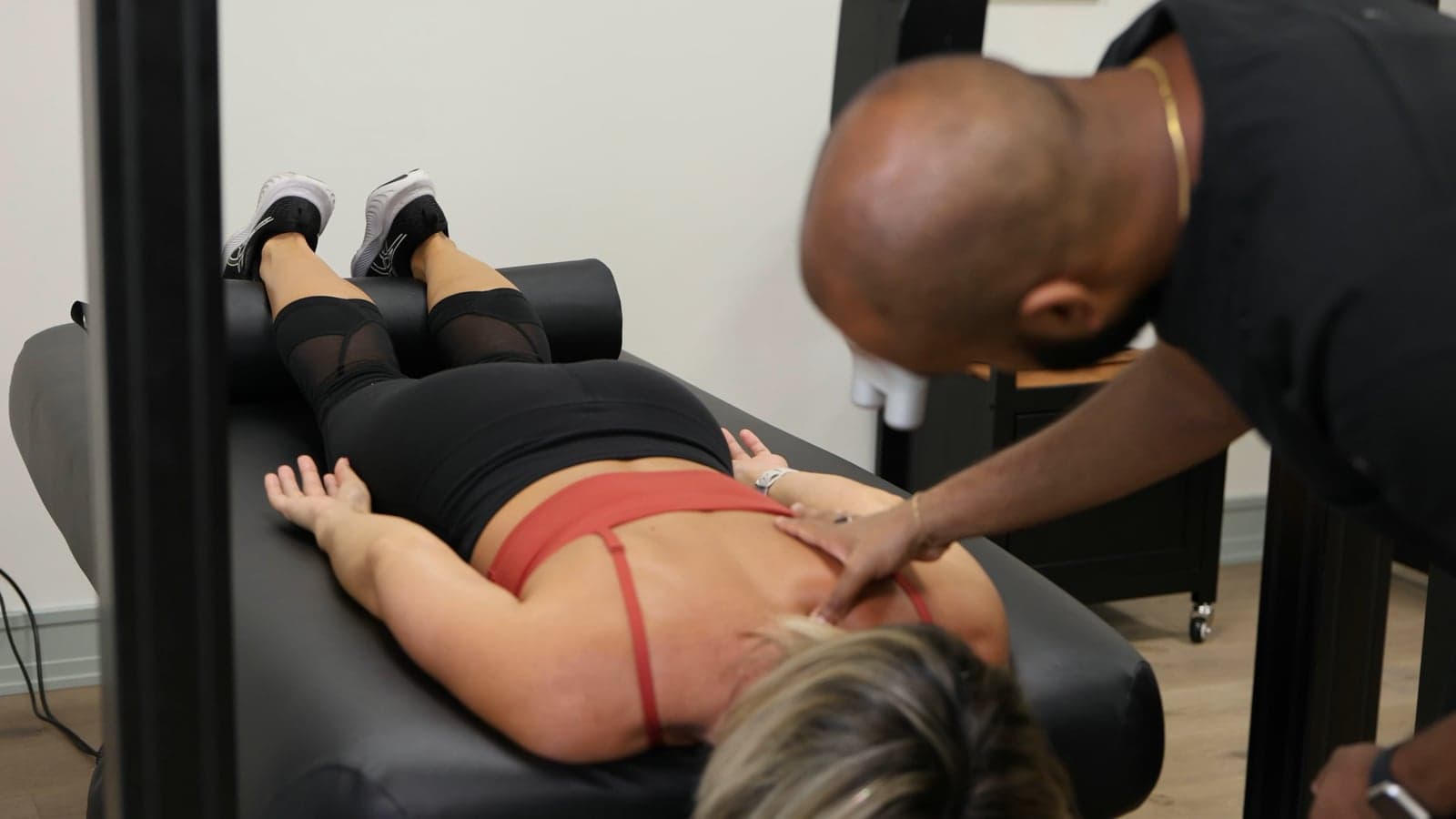
Every plan at TPL starts with the Complete Kinetic Chain Assessment. One hour, one-on-one with Dr. Mani, our Doctor of Physical Therapy. He maps the full chain — the joint imaging flagged plus the segments above and below that are quietly running compensation patterns. By the end of the session you know which links are actually driving your pain.
From there we build a plan around what's broken, not around a diagnosis code. Sessions run as long as the work requires, not as long as an insurance reimbursement allows, because we operate completely outside the insurance model. Cash-pay; HSA and FSA accepted; receipts available for out-of-network reimbursement if you want to chase it.
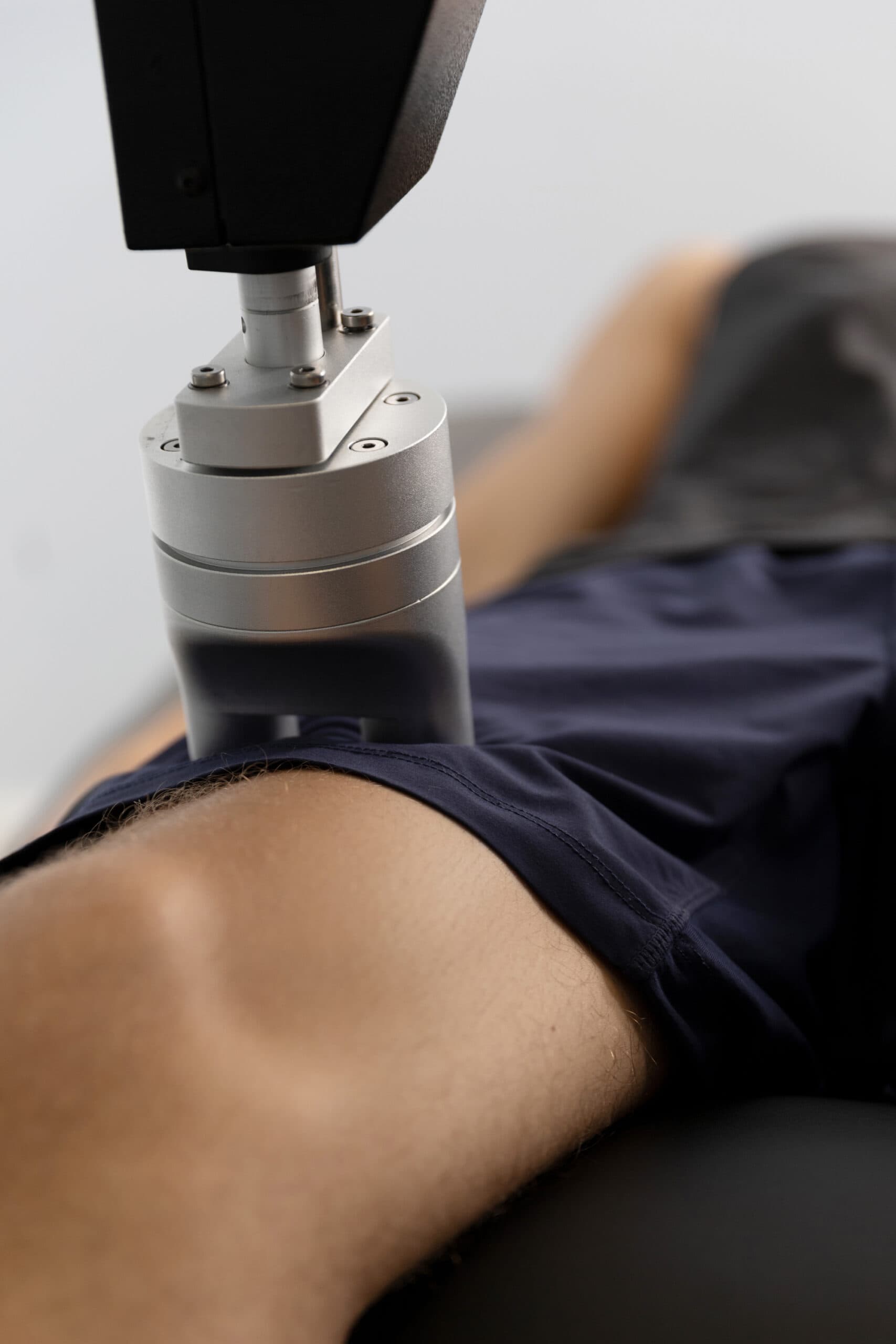
For a chronic case of this condition, the early sessions usually combine depth-controlled tissue work via the RX2600 Therapeutic Robot — work hands alone can't sustain — with the manual therapy and corrective movement that change how load travels through the chain. The point is repeatable change you can feel between sessions, not temporary relief that fades by morning.
Why morning stiffness has nothing to do with the cartilage
"I'm stiff for the first 10 minutes after I get out of bed" is almost universal in chronic joint conditions. It's also the place most people draw the wrong conclusion — assuming the stiffness IS the cartilage wear they were diagnosed with.
It usually isn't.
Joint stiffness that's worse in the morning or after sitting is driven by the soft tissue and synovial fluid that surround the joint, not the cartilage itself. Fluid pools when you're stationary. Muscle and fascia around the joint shorten when you're not asking them to move. Then you stand up, the joint has to move against tissue that's locked down, and it hurts. After 10 minutes of normal movement, fluid redistributes, fascia warms up, and the joint feels closer to normal.
Notice what just happened. The cartilage didn't change between minute 1 and minute 10. The chain around it did.
For someone living with chronic joint pain, this is the leverage point. If the soft tissue and fluid distribution around the joint stay better organized over the course of the day — through deeper tissue work, through movement patterns that don't compound the loading bias, through the work above and below the joint — the "first 10 minutes" stops being your worst window.
The imaging trap: why your X-ray doesn't predict your pain
Joint imaging in chronic degenerative cases is one of the most counterintuitive findings in orthopedic medicine: what shows up on the picture doesn't correlate cleanly with what hurts.
The orthopedic literature has shown for decades that:
- People with severe imaging findings can be completely pain-free.
- People with mild or moderate findings can be debilitated.
- Pain a person reports often tracks better with their movement patterns than with the radiographic grade of their joint.
For a plain-English overview of the condition itself, the Mayo Clinic's primer on joint degeneration is a useful starting point. What matters clinically is what the imaging doesn't tell you: the joint shown in the picture is one link in a kinetic chain, and how the rest of the chain is loading it is what determines whether the wear you can see produces a little pain or a lot.
This is also why the most common playbook for this condition — pain medication, anti-inflammatories, an injection or two, maybe a referral to insurance-based physical therapy focused on the affected joint — often produces relief for a few weeks and then loses ground. The imaging finding is unchanged because nothing changed it. The chain pattern is unchanged because nothing addressed it. Two months later the cycle starts over.
The chronic part of chronic joint pain is the chain pattern, not the cartilage.
Why "rest the joint" and "use it or lose it" both fail
You've probably gotten contradictory advice. The doctor said rest the joint. A friend said "use it or lose it." A trainer told you to push through. The advice fragments because it's missing the load-distribution piece.
Rest the joint without addressing the chain → the chain around the joint gets weaker. When you go back to your old activity level, the joint takes more load through a chain that's now less prepared to share it. Pain comes back worse.
Push through without addressing the chain → the same compensation patterns that produced the disability in the first place layer in deeper. The painful joint gets hammered AND the segments quietly compensating around it (the opposite hip, the lumbar spine, the foot, the thoracic spine) accumulate their own dysfunction. Pain comes back broader.
The piece missing in both prescriptions: distribute the load across the chain so the affected joint doesn't have to do work the rest of the chain has been refusing to share.
A patient with chronic knee pain at TPL typically gets two phases in early sessions. Phase one is restoring ankle dorsiflexion and hip rotation — the segments that should be handling rotation and load absorption the knee is now carrying. Phase two is light, progressive loading of the knee while the chain above and below is doing its job correctly. The knee gets used. It doesn't get hammered.
Frequently asked questions
Can chronic arthritis pain actually go away without surgery?
For many people, yes — but the language matters. The wear visible on imaging won't reverse. What changes is the disability the wear produces: the daily pain, the mobility loss, the days you can't load the joint. When the chain around the affected joint is functioning correctly, the same imaging finding produces dramatically less pain. People who came in unable to ride a bike for more than 20 minutes get back to long rides. Whether you need surgery becomes a question of function, not the X-ray grade.
How long does it take to feel a difference?
Most cases show meaningful change within 3 to 4 sessions. By session 6 to 10, you usually know whether the chain pattern is changing the way you can load the joint day to day. Acute flares calm down faster — often inside one or two sessions — because the early work targets the soft-tissue and fluid layer that's amplifying the flare. The deeper pattern work that holds the change takes longer.
Will exercise make this worse?
Bad exercise will. The right exercise — progressively loaded, applied to a chain that's distributing load correctly — actually protects the joint by building the strength and mobility the compensating segments have lost. Avoidance reinforces the disability. We won't tell you to stop the activity that matters to you. We'll tell you what to do first so the activity stops eating the joint.
What's different about this from the PT I've already tried?
Conventional insurance-based PT is a 45-minute session usually shared between you and one or two other patients, with an aide running most of the work. The treatment is built around your diagnosis code. At TPL, you get a full hour one-on-one with a Doctor of Physical Therapy, the session is built around the chain pattern your assessment found, and there is no insurance constraint shortening your visit. Different setup. Different outcomes.
Ready to find the root cause?
If chronic joint pain has stopped responding to the standard playbook — meds, injections, generic PT — and you're not interested in stopping the activity that keeps you sane, the Complete Kinetic Chain Assessment is the right next step. One hour, one-on-one, full-body. We don't treat where it hurts. We hunt what's causing it.
Book your $99 Complete Kinetic Chain Assessment — no referral needed. We're in Lake Orion, MI, serving active adults across the metro Detroit area.
Get in touch for questions before booking.