Blood Flow Restriction
How Does Blood Flow Restriction Therapy Work? A Plain-English Explainer of the Science
Blood flow restriction therapy uses pressure cuffs to trigger heavy-load strength signals at light-load weights. Here is exactly how it works, in plain English.
Start Feeling Better Today
Stop managing pain. Start hunting the cause.
$99 · No Referral Needed
The guide · 11
- 01Quick Answer
- 02The One-Sentence Mechanism
- 03What the Cuff Actually Does
- 04Why That Triggers a Heavy-Training Response
- 05High-Threshold Motor Units, Without Heavy Weight
- 06The Research Foundation
- 07Why Calibration Matters, and Why TPL Uses SAGA
- 08How BFR Fits Inside a Kinetic Chain Treatment Plan
- 09FAQs
- 10Curious If BFR Is Right for You?
- 11Ready to find the root cause?
The first time most people see a blood flow restriction set, the question is the same. Why does a tiny weight, used while wearing a pressurized cuff, produce the kind of muscle and strength response that normally only comes from heavy training? It looks like a hack. It is not. It is one of the better-studied training and rehab interventions of the last two decades, and the mechanism is straightforward once you know what the cuff is actually doing.
Quick Answer
Blood flow restriction therapy uses a pneumatic cuff placed on the upper arm or upper leg to partially restrict venous return without cutting off arterial inflow. The working muscle below the cuff fatigues quickly under light load and recruits high-threshold motor units that normally only fire during heavy training. The result is a strength and growth response at twenty to thirty percent of normal training load. At Thera Performance Lab, BFR is administered by your Doctor of Physical Therapy during one-on-one sessions using clinical-grade SAGA BFR Cuffs as part of a complete kinetic chain treatment plan.
The One-Sentence Mechanism
A pressurized cuff slows the blood flowing out of the muscle while letting most of it continue flowing in. The result is a metabolic environment inside the muscle that the body interprets as heavy training. Even though the weight on the bar is light.
That is the entire pitch. Everything else is detail about why that single change to the working environment of the muscle produces the response it does.
What the Cuff Actually Does
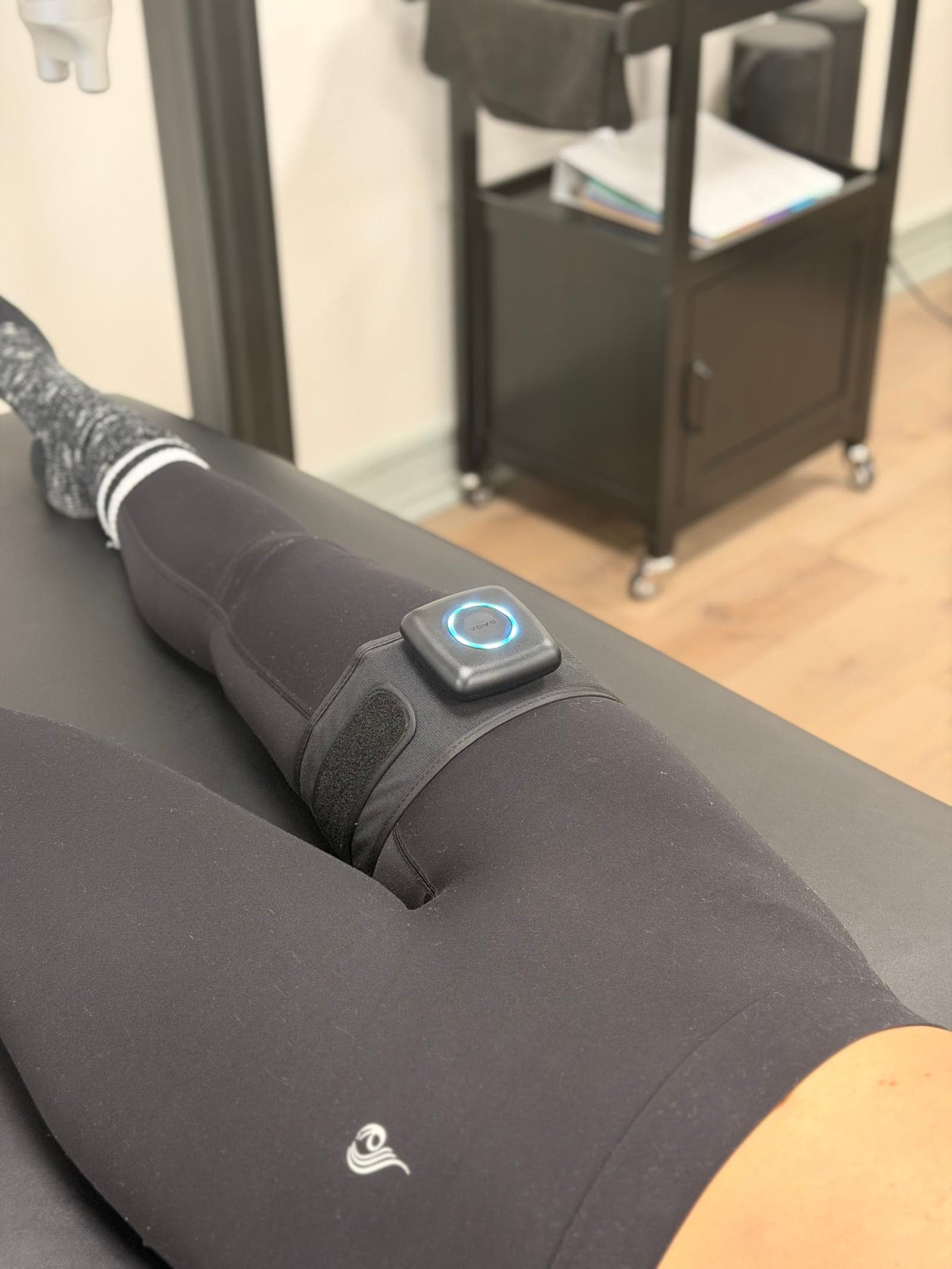
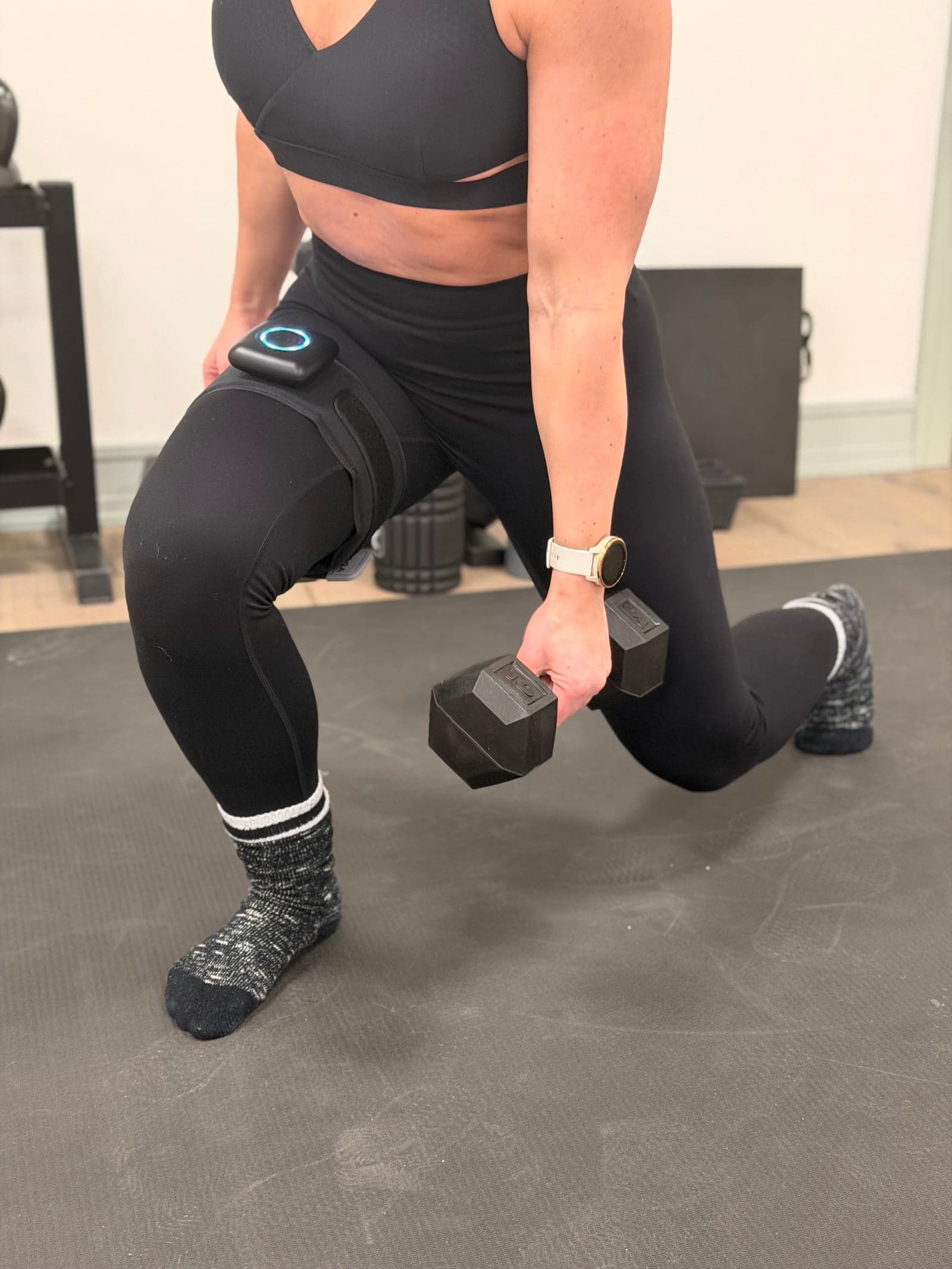
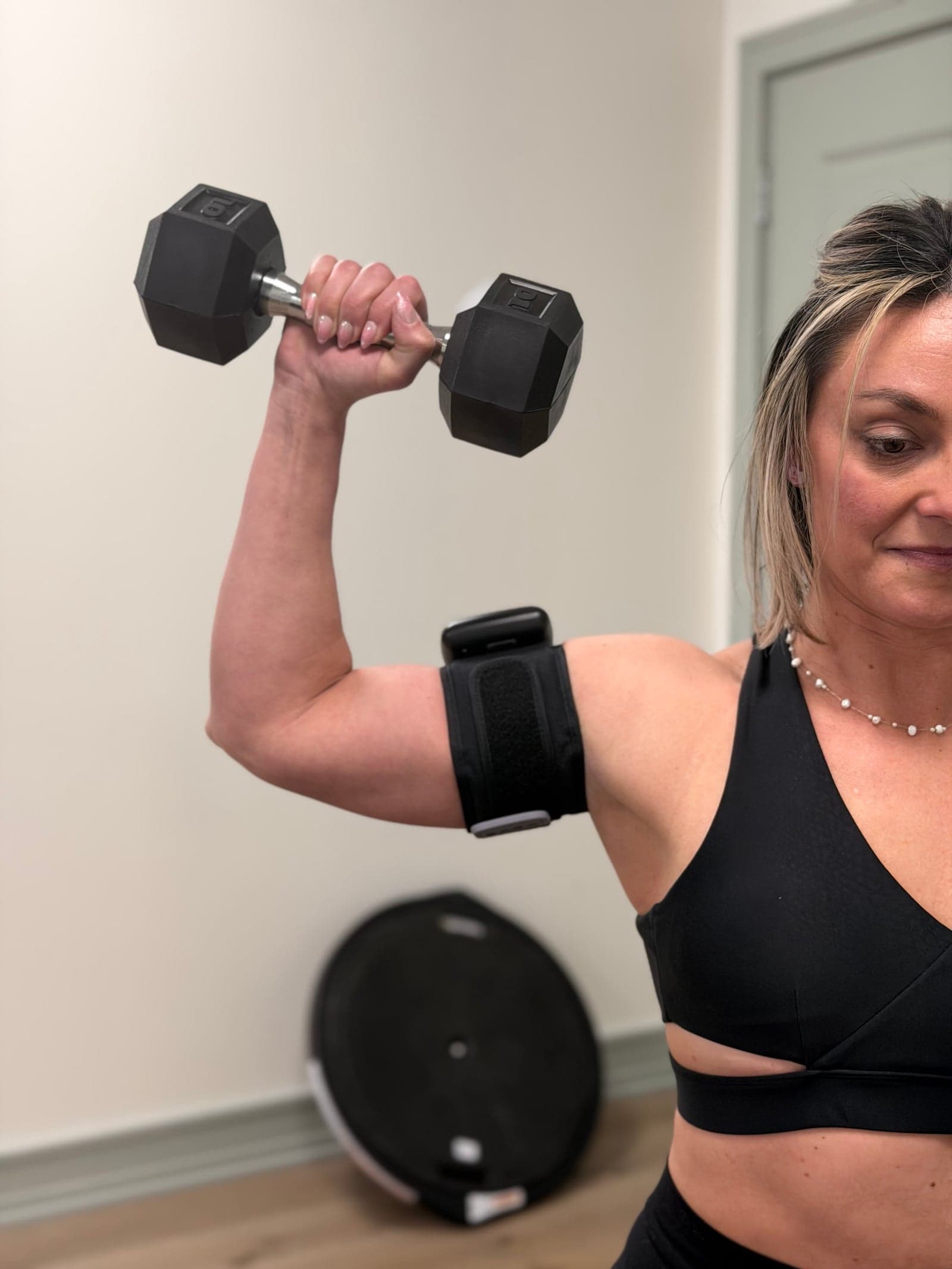
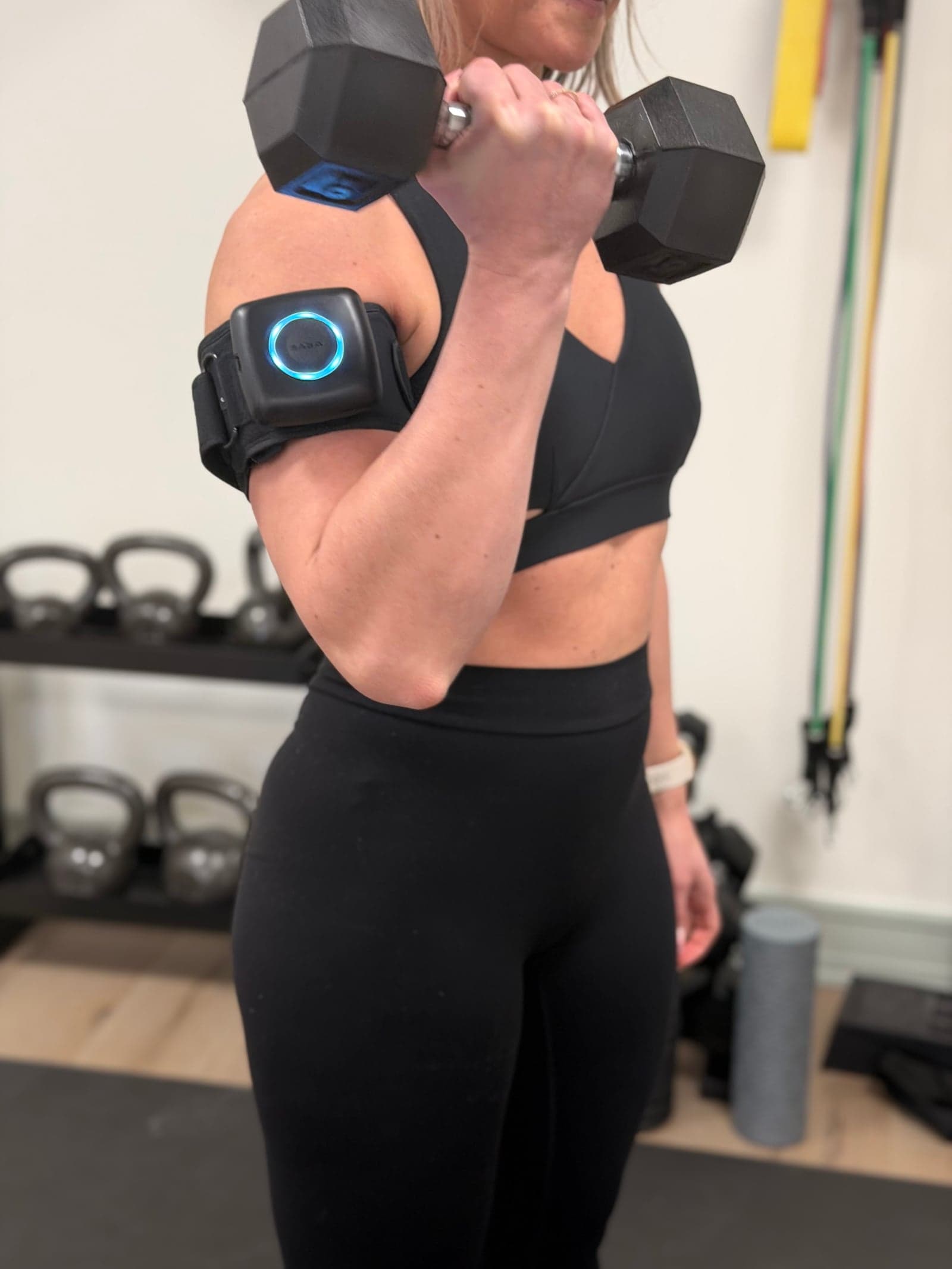
A BFR cuff is a pneumatic band placed on the limb proximal to the working muscle. Upper arm for any exercise targeting the deltoid, biceps, triceps, forearm, or grip. Upper leg for any exercise targeting the quad, hamstring, glute, or calf.
The cuff is inflated to a specific percentage of the patient's full occlusion pressure. Full occlusion is the pressure required to completely stop arterial blood flow into the limb. BFR uses a fraction of that, typically forty to eighty percent of limb occlusion pressure depending on the protocol and the goal.
At that pressure, arterial inflow continues. Venous return is partially restricted. Blood pools in the muscle. Metabolic byproducts of exercise accumulate faster than they can be cleared. Lactate builds. The working muscle reaches a state of metabolic stress at a much lower training load than it normally would.
Why That Triggers a Heavy-Training Response
The body's adaptation to strength training is driven by two main signals. Mechanical tension, which comes from heavy load on the muscle. And metabolic stress, which comes from accumulated byproducts of work. Both signals independently activate the cell-signaling pathways that drive hypertrophy and strength.
Heavy training works because it produces both signals at once. The load is high, so mechanical tension is high. The set is long enough to fatigue the muscle, so metabolic stress is high.
BFR works because it produces metabolic stress to the same degree that heavy training does, without requiring the mechanical tension that comes from heavy load. The cuff is the shortcut to the second signal. The set still has to be done, the reps still have to be performed near failure, but the load on the bar is light enough that the joints, the tendons, and any healing tissue underneath the muscle do not get stressed.
For training purposes, this means you can build strength without spending years of joint wear. For rehab purposes, this means you can build strength without driving load through tissue that cannot tolerate it yet. The mechanism is the same in both cases.
High-Threshold Motor Units, Without Heavy Weight
There is a second reason BFR produces the response it does. Motor unit recruitment.
A muscle is made up of motor units of varying sizes. Small, low-threshold motor units fire first during light work. Large, high-threshold motor units only fire when the small ones can no longer produce the required force. Under normal light-load training, the small motor units handle the work and the large ones never get recruited. No high-threshold stimulus, no high-threshold adaptation.
Under BFR, the small motor units fatigue quickly because of the restricted venous return and the metabolic environment. To keep producing force, the body recruits the large motor units. Within a few reps of a light-load set, the high-threshold units that normally only fire under heavy training are firing under a fraction of the load.
That is why BFR produces gains that look like heavy-training gains. The high-threshold motor units are being trained.
The Research Foundation
BFR is not a new concept. It has been studied for more than two decades, originally under the name Kaatsu training developed in Japan in the 1990s. The modern clinical application has been validated across surgical recovery, injury rehabilitation, sports performance, and aging populations.
Peer-reviewed research has demonstrated strength and hypertrophy outcomes from BFR training comparable to traditional heavy-load training, with significantly lower joint and tissue stress. Systematic reviews have confirmed safety profiles across clinical populations when the protocol is supervised and pressures are calibrated correctly.
This is not a fringe intervention. It is one of the more rigorously studied training and rehab tools available, and major orthopedic and sports-medicine programs have incorporated it into surgical recovery protocols in the past decade.
Why Calibration Matters, and Why TPL Uses SAGA
The single largest variable in BFR effectiveness and safety is pressure calibration.
The right pressure depends on the patient's limb size, limb composition, and the specific exercise being performed. Too low and the metabolic environment never reaches the threshold for the response. Too high and the patient is uncomfortable, the set quality drops, and certain contraindications get pushed closer to the surface.
Older BFR systems require the clinician to take a Doppler reading, dial in a pressure cuff manually, and hope it holds through the set. That worked in research labs. In a busy treatment session, it created a real problem. The clinician's attention was on the equipment, not the patient.
SAGA BFR Cuffs, engineered with input from Dr. Mike MacPherson, PhD, CSCS, solve that problem with auto-calibration. The cuffs read the patient's limb size, compute the correct occlusion percentage, hold it through the set, and log the data. The therapist focuses on the patient. The equipment runs the protocol.
That is why TPL uses SAGA. It is the cleanest implementation of clinical BFR currently available.
How BFR Fits Inside a Kinetic Chain Treatment Plan
BFR is a tool. It is not a complete treatment plan on its own. At TPL, BFR sits inside a kinetic chain assessment and treatment framework that addresses how the entire body moves together.
The assessment finds the actual cause of the pain, the injury, or the limited mobility. The treatment plan addresses the structural side with manual therapy, the RX2600 robotic precision therapy system for sustained pressure work, dry needling where indicated, and progressive loading to restore strength and movement quality. BFR is layered in when one or more chain links need to keep training while another link is offline.
The point is not "we do BFR." The point is "we have a treatment plan, and BFR is one of the tools we use inside it when it is the right tool."
FAQs
Does BFR actually work, or is it just a trend?
It works. The peer-reviewed evidence is substantial across multiple populations, including post-surgical rehab, injury recovery, older adults, and competitive athletes. The strength and hypertrophy outcomes have been replicated across enough independent studies that it is now standard in many surgical rehab protocols.
Is BFR safe?
When applied with appropriate screening, calibrated pressures, and clinical supervision, BFR has an excellent safety record. Specific contraindications exist, including certain cardiovascular and vascular conditions, and a Doctor of Physical Therapy screens for these before any cuff goes on.
How long does a BFR set take?
A typical BFR set is three to four sets of fifteen to thirty reps at low load, with short rest intervals between sets. The full BFR portion of a session is usually ten to twenty minutes inside a longer treatment hour.
Can I do BFR at home?
With the right cuffs and the right protocol established by your Doctor of Physical Therapy, yes. Many TPL clients continue clinical-protocol BFR at home between sessions or after discharge. SAGA BFR Cuffs are the same cuffs we use in clinic. Use code THERA at saga.fitness for 10% off if you are a TPL client.
Curious If BFR Is Right for You?
If you are dealing with an injury, a post-surgical recovery, a chronic issue, or simply want a way to train at lower joint load while still building strength, BFR may be part of the answer. The right answer depends on what is actually causing the issue or limiting the training. That is why every treatment plan at TPL starts with a Complete Kinetic Chain Assessment.
Book your $99 Complete Kinetic Chain Assessment at Thera Performance Lab in Lake Orion to find out whether BFR belongs in your plan, and what the rest of the plan should look like alongside it.
Ready to find the root cause?
If you've been working through sports injuries and want a root-cause path forward, this is the work Thera Performance Lab does every day. Sessions run inside our Sports Performance & Recovery track, typically anchored by Blood Flow Restriction Training as one of the precision tools in a personalized kinetic-chain plan.
Book a Complete Kinetic Chain Assessment — $99, no referral needed.